
A unit is down, the repair number lands on your desk, and you have to decide whether to spend it or spend considerably more. Residential rules of thumb — replace if the repair exceeds half the cost of new — do not transfer well to commercial equipment, where access, downtime, and tenant impact dominate the arithmetic.
Here is the framework we actually walk through with owners.
1. What failed, and what does that predict?
Not all failures carry the same signal. A contactor, a capacitor, a board, a belt — these are wear items and say almost nothing about the rest of the unit. A compressor or a leaking evaporator coil is a different message: those are the expensive core components, and their failure usually means the unit has done its service life rather than had bad luck.
2. How old is it, honestly?
Get the age from the nameplate serial, not from memory or from whoever owned the building before you. Then be realistic: a well-maintained unit in a mild application outlives a neglected one in a grease-laden or coastal environment by years. Age alone is not the answer, but age plus a core-component failure very nearly is.
3. What is the repair history?
One repair is an event. Three service calls in eighteen months is a pattern, and patterns do not reverse. This is the question most owners cannot answer, which is itself informative — if nobody has the history, you are deciding blind, and that is worth fixing regardless of what you do with this unit.
4. What does the refrigerant situation add?
If the unit runs R-410A and has a chronic leak, factor in a service commodity that gets more expensive as production caps step down. It does not force your hand, but it moves a marginal call toward replacement. A tight system is much less affected.
5. What does the access cost either way?
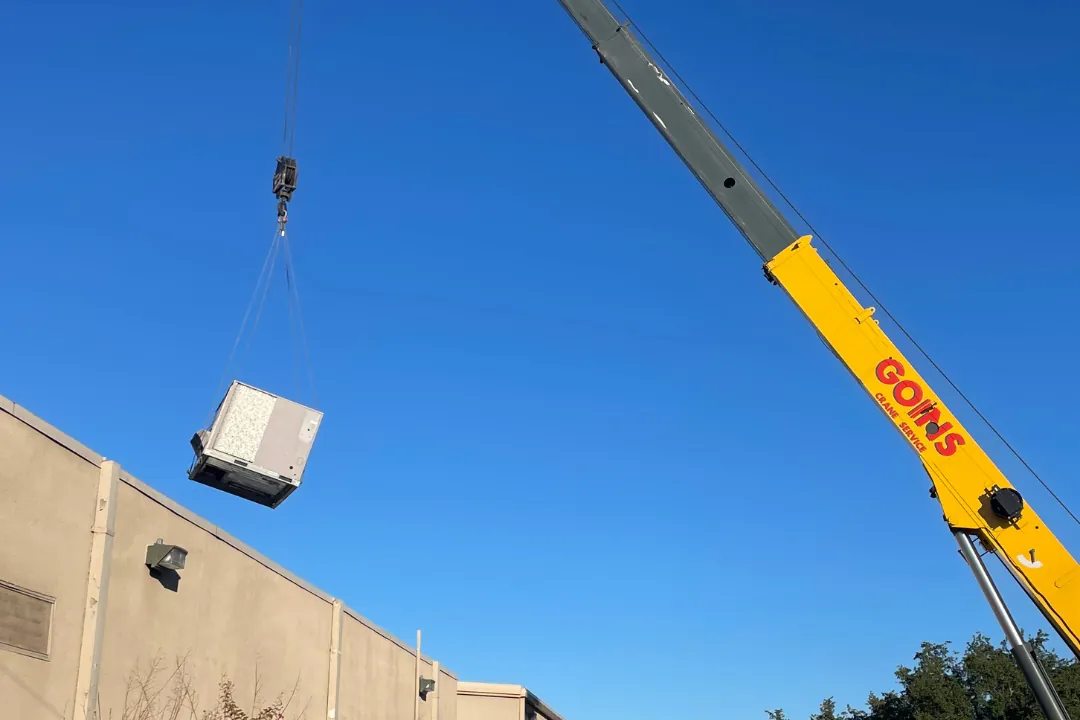
This is the commercial-specific factor that residential rules ignore entirely. If the unit needs a crane to come down, you pay much of that mobilization whether you are replacing it now or in three years. When a crane is already scheduled and the roof is already open, replacing an adjacent unit that is nearly as old is often the cheapest it will ever be. Grouping changeouts is real money.
6. What does downtime cost you?
A restaurant dining room, a clinic waiting room, a data closet, and a warehouse aisle have wildly different tolerances. If a failure in August closes revenue space, reliability is worth paying for in a way that a spreadsheet comparing equipment prices will never show.
Where we land most often: repair wear items at almost any age. On a core-component failure in a unit past its expected life, with a repair history and crane access, replace — and look hard at whether the unit next to it should go at the same time.
What you should get from a contractor
Both numbers, and the reasoning. The repair cost with what it does and does not address, the replacement cost with the full scope, and a straight opinion about the next three years. Anyone who will only quote one option has not given you enough to decide with.
We will tell you which one we would do if we owned the building. Sometimes that is the repair, and it costs us the bigger job. That is fine — the alternative is selling equipment somebody did not need, which is a short business.