When a rooftop unit dies and you put the work out for quotes, the numbers usually come back further apart than you expected. That spread is rarely one contractor being greedy and another being generous. It is almost always a difference in what each one included — and what they are assuming they will find when they get up there.
Here is what actually moves the number, roughly in order of impact.
1. Getting the old unit down and the new one up
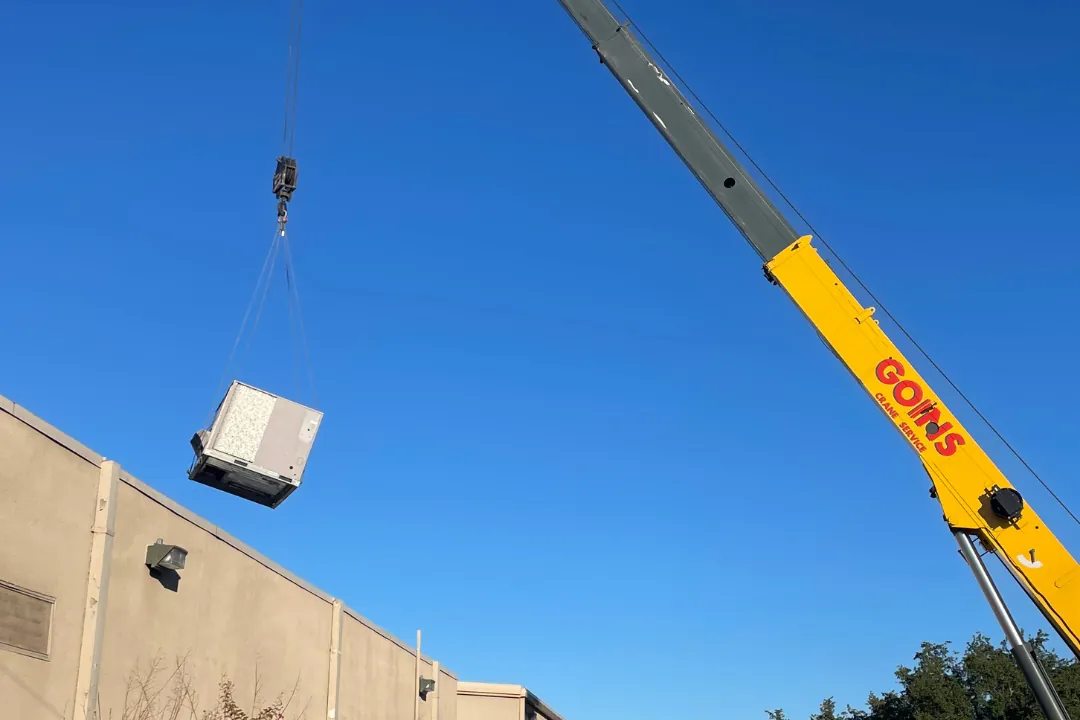
This is the line item that surprises people most. A ground-level condenser is a couple of hours with a hand truck. A 20-ton package unit on a four-storey roof with no crane access on three sides is a different job entirely — street closure permits, a bigger crane, a Saturday to avoid tenant disruption, and a spotter crew. On tight sites the answer is sometimes a helicopter lift, which is dramatic but is priced by the minute and needs airspace coordination.
If two quotes are far apart and the equipment is identical, rigging is the first place to look.
2. Whether the new unit fits the old curb
Manufacturers change footprints between generations. A replacement rarely sits cleanly on a fifteen-year-old curb, and you have two options: a factory curb adapter, or fabricated transitions built to the opening you actually have.
This is the single biggest reason we keep our own sheet metal shop. A curb adapter on back-order is a unit sitting in our warehouse while your space runs on portable cooling. Built in-house, it is a measurement and a couple of days.
3. Electrical — and what the panel can actually support
Newer high-efficiency equipment does not always draw what the old unit drew. Sometimes it draws less, which is fine. Sometimes the MCA and MOCP push you past the existing breaker, the disconnect, or the conductor size, and now you are in the panel. Occasionally there is no spare capacity at all and the conversation becomes a service upgrade.
A proposal that does not mention the electrical scope either verified it or is going to come back to you as a change order. Ask which.
4. Controls and integration
If the building has a BAS, the new unit has to talk to it. Protocol mismatches, new control boards, and re-commissioning points take time that has nothing to do with the mechanical install. If the site runs on standalone thermostats, this line is small. If it runs on a twelve-year-old front end, it is not.
5. Ductwork and airflow you inherit
A new unit will not fix an undersized duct system — it will just be a newer unit fighting the same static pressure. If the existing distribution is marginal, replacement is the cheapest moment you will ever have to correct it, because the roof is already open and the crew is already there.
What to ask for in a quote: rigging method and who pulls the permits, curb adapter versus fabricated transition, the electrical scope with verified MCA/MOCP, controls integration hours, and what happens to the old unit. If all five are addressed, you can compare bottom lines fairly. If they are not, you are comparing guesses.
6. Code, permits, and inspection
Jurisdictions differ on what triggers a permit and what has to be brought current when you touch equipment. Economizers, outside-air requirements, condensate routing, roof penetrations, and clearances can all come into scope on a replacement. This is not padding — it is the difference between a job that passes inspection and one that gets a correction notice.
The honest summary
Equipment is often less than half the cost of a rooftop replacement. The rest is access, adaptation, power, controls, and code. When you are reading proposals, the useful question is not "who is cheapest" but "who has actually been on my roof and priced what is up there."